Boundary Schwarz lemma and rigidity of holomorphic mappings
Speaker: 唐笑敏 (湖州师范大学)
Time: 2026年10月13日 16:30-17:30
Venue: 吉林大学伍卓群楼第五研讨室
Abstract: In this talk, we will establish the Schwarz lemma at the boundary, and present the rigidity property for holomorphic mappings on some bounded domains. Meanwhile, we will introduce some new progress about the boundary Schwarz lemma and Burns-Krantz rigidity.
Bio: 唐笑敏,湖州师范大学教授,浙江省新世纪“151”第二层次人才、浙江省高校创新领军人才。从事多复变函数论的研究,在《Sci. China Math.》《Adv. Math.》《Math. Ann.》《Tran. AMS》《CMP》等期刊发表论文50余篇;主持国家自然科学基金项目3项、浙江省自然科学基金重点项目1项和一般项目3项,获得浙江省自然科学奖二等奖1项、浙江省教学成果奖二等奖1项。
Previous lectures and talks:
Quantization of minimal nilpotent orbits and the quantum Hikita conjecture
Speaker: Xiaojun Chen (New Uzbekistan University)
Time: October 8, 2026, 20:00-21:00
Venue: Zoom Id: 904 645 6677,Password: 2026
Abstract: In the past two decades 3d N=4 mirror symmetry has been widely studied by physicists and mathematicians. It is also closely related to symplectic duality proposed by Braden et al. One of the conjectures in this field, initiated by Hikita, says that the cohomology of one symplectic manifold is isomorphic to the coordinate ring of the torus-fixed scheme of its symplectic dual. In this talk we show a quantum version of Hikita’s conjecture between Kleinian singularities and the corresponding nilpotent orbits. This talk is based on a joint work with Weiqiang He and Sirui Yu.
Bio: Prof. Xiaojun Chen is a mathematician specializing in noncommutative geometry, representation theory, and algebraic geometry. Over the past decade, he has held academic positions and engaged in collaborative research across China and internationally. He is widely recognized for his work on Calabi-Yau algebras, Poisson structures, and derived categories. Throughout his career, Prof. Chen has co-authored numerous high-impact papers and mentored early-career researchers in mathematical physics and pure mathematics.
组合Yamabe复杂度与三维流形的几何化
Speaker: 葛化彬 (中国人民大学)
Time: September 24, 2026, 10:30-11:30
Venue: 吉林大学正新楼209
Abstract: 本报告基于三维球堆积及相应的变分与几何分析框架,引入组合 Yamabe 复杂度,并证明它与 Matveev 复杂度双边可比;经过有限覆盖稳定化后,又与 Gromov 范数双边可比,因此能够反映三维流形 JSJ 分解中的双曲部分,并且恰在图流形上消失。相比之下,未稳定化的组合 Yamabe 复杂度还能保留更细的信息,例如 mapping torus 中的 monodromy,而 Sol 流形正好体现了稳定化前后所捕捉到的三维几何拓扑信息的差别。这些结果来自与贾龙松的合作研究。
Bio: 葛化彬,北京大学博士、博士后,现为中国人民大学数学学院教授、博士生导师。2025年获国家自然科学基金青年科学基金项目(A类)资助。主要从事三维流形的几何与拓扑研究。其合作研究推广了柯西刚性定理与 Thurston 圆堆积理论,部分解决了 Thurston 几何剖分猜想,并完全解决了 Cheeger–Tian 与林芳华提出的相关正则性猜想。近年来的研究逐步形成两条相互关联的主线:一条围绕组合 Ricci 流及其在三维双曲化、几何拓扑结构和 Thurston 几何三角剖分中的作用展开;另一条从无穷圆堆积与无穷双曲多面体出发,研究无穷组合拓扑结构及其几何实现,并进一步探讨其与随机游走、边界理论和随机三维几何之间的联系。
辛奇点简介
Speaker: 付保华 (中科院数学与系统科学研究院)
Time: September 23, 2026, 10:10-11:10
Venue: Zoom Id: 904 645 6677,Password: 2026
Abstract: 辛奇点是代数几何与辛几何交叉的一个研究领域,现在在几何表示论,数学物理等方面也引起了诸多的研究。我将简要介绍一些相关知识与进展。
Bio: 付保华本科毕业于北京大学,之后赴法留学,2003年获法国尼斯大学的博士学位,之后在法国CNRS工作数年。现为中科院数学与系统科学研究院的研究员。主要从事代数几何的研究,在辛奇点及其辛解消,带群作用的Fano簇的分类等方向做了系列工作。
On Some Constructions of n-Lie Algebras
Speaker: Bakhrom Omirov (Institute for Advances Study of Mathematics, Harbin Institute of Technology)
Time: September 15, 2026, 16:00-17:00
Venue: 吉林大学正心楼209
Abstract: We study constructions of n-Lie algebras, with particular attention to infinite-dimensional simple examples. First, we investigate Pozhidaev’s algebras using equivariant bilinear maps, 1/n-derivations, and inner derivation algebras. These invariants distinguish them from the full algebras arising from the standard S, W and SW constructions. We also describe realizations through derived subalgebras and central quotients, clarifying the scope of this distinction.
Next, we consider determinant brackets defined by commuting derivations and additional columns of algebra elements. Using complementary minors and Grassmann–Plücker relations, we obtain an explicit criterion for these brackets to define n-Lie structures and illustrate it with concrete examples. Finally, we discuss tensor products and quotient constructions relating ordinary algebras to n-Lie algebras.
This talk is based on joint work with Xinru Cao and Zafar Normatov.
Bio: Bakhrom Omirov is a professor at the Harbin Institute of Technology, Institute for Advances Study of Mathematics. He graduated Novosibirsk State University (Russia), got his PhD (2002) and Doctor of Sciences (2006) degrees at Institute of Mathematics of Uzbekistan Academy of Sciences. His research focused on solvable Lie and Leibniz (super)algebras, n-Lie algebras and finite-dimensional Poisson algebras. He published more than 120 publications.
Bakhrom Omirov is a member of The World Academy of Sciences (TWAS) for the advancement of science in developing countries and were awarded by "Top Researcher in Natural Sciences" Scopus Award (2018), Web of Science Awards in the category of "Highly cited author" (2017) and with the highest state prize of the Republic of Uzbekistan in the field of science and technology (2017).
局部指标理论: 从指标到解析挠率与eta不变量
Speaker: 麻小南 (南开大学陈省身数学研究所)
Time: September 14, 2026, 16:00-17:00
Venue: 吉林大学正心楼209
Abstract: 对一个椭圆算子,我们可以定义它的指标及行列式,若它自伴,它的eta不变量是自伴矩阵的符号差的无穷维版本,他们都是通过算子的特征值组合定义。我们将介绍它们在几何,拓扑与数论中的应用。这其中热核算子是一个中心工具,特别是联系局部到整体的桥梁。
Bio: 麻小南, 现为南开大学讲席教授,陈省身数学研究所所长,国际数学家大会(ICM)报告人,国家自然科学基金创新研究群体项目带头人。麻小南的主要研究领域为微分几何、复几何以及拓扑。他尤其专注于流形上的指标理论以及整体分析的研究. 麻小南与张伟平曾运用解析局部化的思想和技巧,解决了法国科学院院士Vergne在2006年国际数学家大会全会报告中提出的非紧空间上的几何量子化猜想。麻小南曾多次获得国际大奖:2006年西班牙费兰·苏涅尔·巴拉格尔(Ferran Sunyer i Balaguer)奖、2017年法国科学院索菲·热尔曼(Sophie Germain)年度大奖、2022年德国 盖·吕萨克—洪堡(Gay-Lussac-Humboldt)奖。麻小南也是中科大中法数学班,武汉大学中法数学班的教育委员会秘书长,负责所有法方事务。
Plato晶体和McKay对应
Speaker: Naihuan Jing (North Carolina State University)
Time: August 30, 2026, 16:00-17:00
Venue: 吉林大学数学楼第五研讨室
Abstract: 希腊先贤柏拉图曾用正则晶体来描述世界万物。我们先讨论Plato晶体的分类,进而用他们的对称群说明和仿射李代数的对应关系--McKay correspondence, 并通过圈群表示的模范畴的基本运算来构造最基本的无限维李代数。这种范畴化方法也适用于构造量子仿射代数和量子圈代数。
Bio: 景乃桓,耶鲁大学博士,北卡州立大学终身教授。主要从事无限维李代数、量子群、表示论、代数组合和量子计算方面的研究工作。景乃桓教授在对称函数方面的研究成果被国际上命名为“景氏算子”,在国际主要数学刊物上发表近百篇论文,编辑著作5部
Post-Hopf algebras and post-Lie algebras: two adjunctions and two extensions
Speaker: Andrea Sciandra (Universit´e Libre de Bruxelles)
Time: August 27, 2026, 21:00-23:00
Venue: Zoom ID: 904 645 6677,Password: 2026
Abstract: Post-Lie algebras were introduced by Vallette in an operadic context, and were later shown to arise from flat connections on smooth manifolds with covariantly constant torsion, from numerical integration on manifolds, and from relative Rota–Baxter operators of weight 1. Their Hopf-theoretic counterparts, postHopf algebras, were introduced by Li, Sheng and Tang, and in the cocommutative case they are equivalent to Hopf braces and to matched pairs of actions, hence they produce solutions of the quantum Yang–Baxter equation. Two adjunctions govern this picture: one between cocommutative post-Hopf algebras and relative Rota–Baxter operators on cocommutative Hopf algebras, and one given by the universal enveloping algebra and primitive elements functors between post-Lie algebras and post-Hopf algebras, the latter restricting to an equivalence on connected cocommutative objects (a post-analogue of the Cartier–Milnor–Moore theorem).
In this talk, I will discuss two independent extensions of this picture. First, I will remove the cocommutativity assumption: replacing Hopf algebras by Hopf monoids in a category of Yetter–Drinfeld modules leads to Yetter–Drinfeld post-Hopf algebras and Yetter–Drinfeld relative Rota–Baxter operators, between which the first adjunction still holds; the corresponding structures are equivalent to matched pairs of actions on arbitrary Hopf algebras and produce solutions of the quantum Yang–Baxter equation in the noncocommutative setting, with interesting examples coming from coquasitriangular Hopf algebras via Majid’s transmutation.
Second, I will discuss infinitesimal deformations of post structures, keeping the Lie bracket (respectively, the Hopf algebra structure) undeformed. This yields the notions of infinitesimal post-Lie algebra and infinitesimal post-Hopf algebra, for which the second adjunction, together with the Cartier–Milnor–Moore equivalence, is shown to lift. Along the way I will provide a classification of infinitesimal post-Lie structures on sl(2) and infinitesimal post-Hopf structures on Sweedler’s Hopf algebra, exhibit a Hochschild 2-cocycle on the subadjacent Hopf algebra in the cocommutative setting, and prove that the quadratic operad of infinitesimal post-Lie algebras is Koszul, by means of a filtered distributive law between the operads of Lie algebras and of bi-magmas. This second part is based on a recent joint work with A. Rivezzi and T. Weber.
Bio: Andrea Sciandra is a postdoctoral researcher at the Universit´e Libre de Bruxelles. He obtained his PhD in December 2025 from the Universit`a di Torino and Politecnico di Torino, with a thesis on Hopf-algebraic structures related to the quantum Yang–Baxter equation. His research interests lie in abstract and categorical algebra, in particular Hopf algebras and their generalizations, skew braces, braided monoidal categories and semi-abelian categories.
Pseudo-derivations (-endomorphisms) of vertex algebras, and vertex bialgebras
Speaker: Haisheng Li (Rutgers University-Camden)
Time: July 21, 2026, 10:30-11:30
Venue: 吉林大学伍卓群楼研讨室5
Abstract: In the classical (Lie and associative) algebra theory, the notions of derivation and automorphism play a fundamental role. For any nonassociative algebra A, its derivations and automorphisms give (important examples of) a Lie algebra Der(A) and a group Aut(A), respectively. On the other hand, the universal enveloping algebras of Lie algebras and the group algebras form an important class of (cocommutative) Hopf/bialgebras. In this talk, we shall discuss vertex-analogues of the notions of derivation, (end)automorphism, and bialgebra, which are called pseudo-derivation (due to Etingof-Kazhdan), pseudo-endomorphism, and vertex bialgebra. We present some basic results and give some applications. In particular, for any nonlocal vertex algebra V, we introduce a classical associative algebra B(V) which contains all pseudo-derivations and pseudo-endomorphisms and prove that B(V ) is naturally a (nonlocal) vertex bialgebra if V is non-degenerate in the sense of Etingof-Kazhdan. Pseudo-derivation was used by Etingof-Kazhdan in their study of deformation quantization of vertex algebras, while pseudo-endomorphism was implicitly used before to construct simple current modules for vertex algebras and has been used in the deformation construction of quantum vertex algebras.
Bio: Haisheng Li is a professor of Rutgers University-Camden. His main research is on vertex operator algebras and quantum vertex algebras. Among the main results are conceptual constructions of vertex algebras and their modules, twisted modules; A theory of quasi modules; A theory of (weak) quantum vertex algebras and φ-coordinated modules; A conceptual association of double Yangians and quantum affine algebras with quantum vertex algebras. He published more than 100 articles in Duke Math. J., Com. Math. Phys., Adv. Math., Tans. AMS and other Internationally renowned journals.
Quasi-Whittaker modules
Speaker: Kaiming Zhao (Wilfrid Laurier University, Waterloo, Canada)
Time: July 20, 2026, 16:00-17:00
Venue: 吉林大学伍卓群楼研讨室5
Abstract: In this talk, a general setting is proposed to define a class of modules over nonsemisimple Lie algebras induced by a nonperfect ideal. This class of Lie algebras includes many well-known Lie algebras, and some of this class of modules are Whittaker modules and others are not. By introducing a new concept: the Whittaker annihilator for universal quasi-Whittaker modules, we are able to determine the necessary and sufficient conditions for the irreducibility of the universal quasi-Whittaker modules. In the reducible case, we can obtain some maximal submodules. The talk is based on a joint paper with C. Cheng, W. Gao, S. Liu and Y. Zhao.
Bio: 赵开明,加拿大Wilfrid Laurier大学教授,主要研究方向为李代数。主持多项国家自然科学基金, 及加拿大NSERC基金。他在 Adv. Math., Tran. AMS, J. Lond. Math. Soc., J. Algebra 等国际刊物上发表学术论文100多篇。
Enriched and Extended Shuffle Algebras from Multiple Zeta Values
Speaker: Li Guo (Rutgers University-Newark)
Time: July 19, 2026, 16:00-17:00
Venue: 吉林大学伍卓群楼第5研讨室
Abstract: The algebra of multiple zeta values (MZVs) is encoded as a shuffle (quasi-shuffle) algebra and a shuffle algebra. The MZV shuffle algebra has a natural Hopf algebra structure which has important applications to MZVs. Recently the MZV shuffle algebra is equipped with a Hopf algebra structure. The needed coproduct is defined by a recursion through a family of weight-increasing linear operators, and can be recovered from a differential locality Hopf algebra on Chen fractions. On the other hand, the MZV shuffle algebra naturally extends to a larger shuffle algebra that corresponds to MZVs with arbitrary arguments, and another Hopf algebra structure is given to the subalgebra for negative arguments. Moreover, the two Hopf algebras are naturally related by a duality. This talk will give a survey of these results, obtained in joint works with Wenchuan Hu, Hongyu Xiang and Bin Zhang.
Bio: 郭锂,美国罗格斯大学纽瓦克分校教授。他的数论工作为怀尔斯证明费马大定理的文章所引用,并将重整化这一物理方法应用于数学研究。他近年来推动Rota-Baxter代数及相关数学和数学物理的研究,应邀为美国数学会在“What Is”栏目中介绍Rota-Baxter代数,并出版这个领域的第一部专著。研究涉及结合代数,李代数,Hopf代数,operad,数论,组合,计算数学,量子场论和可积系统等广泛领域。
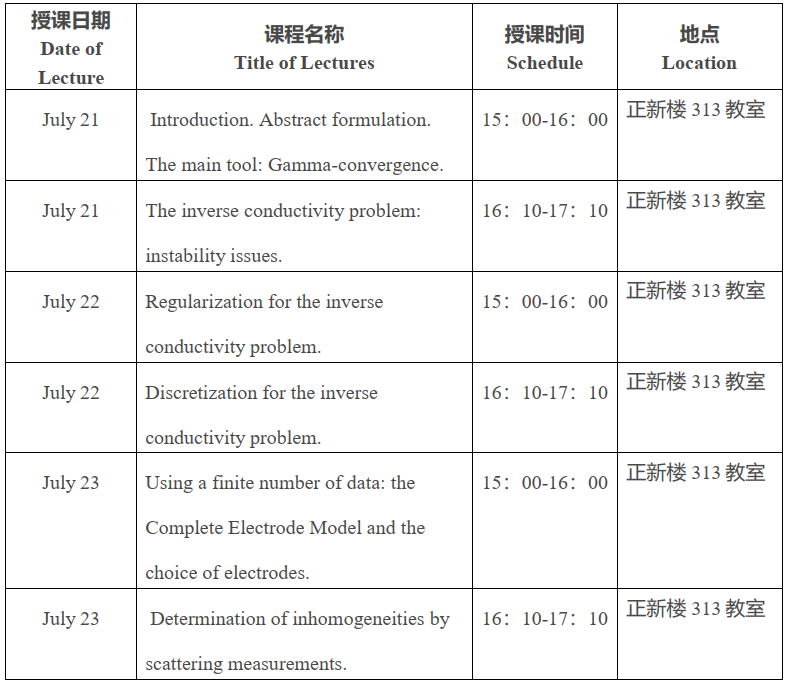
Regularization and discretization issues in the reconstruction for elliptic inverse problems
Speaker: Luca Rondi (Università di Pavia)
Time: July 21,22,23, 2026
Venue: 吉林大学正新楼313教室
Abstract: We discuss the variational approach to the reconstruction for elliptic inverse problems such as the electrical impedance tomography or the determination of inhomogeneities by scattering measurements. When approaching the reconstruction for inverse problems, two of the main difficulties one has to face are nonlinearity and ill-posedness. In fact, most inverse problems are ill-posed, that is, they lack stability. For elliptic inverse problems, the ill-posedness, or instability, is severe or exponential making the reconstruction particularly challenging. To deal with the ill-posedness, some kind of regularization is required which, in the variational approach, is often of Tikhonov type. The discretization used for the numerical implementation may be another important cause of instability, which is often overlooked. We investigate how to handle simultaneously the regularization and the discretization so that the solution to the corresponding regularized and discrete minimization problem is a good approximation of the looked-for solution to the inverse problem.
Bio: Luca Rondi graduated in Mathematics at the Università di Trieste in 1996 and obtained his Ph.D. in Mathematics at SISSA, Trieste, in 1999 under the supervision of Professor Giovanni Alessandrini. From November 1999 till June 2000, he was a postdoc research assistant at Johannes Kepler University of Linz, Austria. During the academic year 2000-2001, he was a Dunham Jackson Assistant Professor at the University of Minnesota, Minneapolis, USA. From September 2001 till December 2012, he was Assistant Professor in Mathematical Analysis at the Università di Trieste. Since December 2012 he has been Associate Professor in Mathematical Analysis, at the Università di Trieste till September 2018, at the Università di Milano till April 2021, and at the Università di Pavia from May 2021. He held long visiting position at the University of Minnesota, Minneapolis (2007 Fall term) and at MSRI, Berkeley, USA (one month in 2010). His fields of research are partial differential equations, with a particular focus on inverse problems, Calculus of Variations and imaging. He has been a member of the Editorial Board of the journal “Communications on Analysis and Computation” (CAC) since its inception in 2023.
Schedule:
An introduction to the theory of coalgebras
Speaker: Maxim Goncharov (Sobolev Institute of Mathematics)
Time: July 15-18, 20-23, 2026, 15:30-16:30
Venue: Zoom ID: 904 645 6677,Password: 2026
Abstract: Main purposes of the course are to introduce the foundations of the theory of coalgebras (that is considered as a part of the theory of Hopf algebras), as well as to acquire an experience in working with coalgebras that will simplify the future deeper study in this area. Namely, we will discuss basic concepts and main examples of coalgebras, comodules, the dual coalgebra and the final dual coalgebra of an algebra.
Indicative course program:
1. Tensor product of vector spaces.
2. Definition of coalgebras. Basic examples.
3. Subcoalgebras and coideals. The Fundamental Theorem of Coalgebras.
4. The factor coalgebra. Group-like elements.
5. The dual (co)algebra.
6. The finite dual of an algebra.
7. Comodules. The fundamental Theorem of Comodules.
8. Rational modules
Bio: Maxim Goncharov: PhD, a senior research fellow of the Sobolev Institute of Mathematics and an associate professor of Novosibirsk State University. Maxim Goncharov specializes in the study of nonassociative rings and algebras, nonassociative bialgebras, Lie bialgebras, Malcev bialgebras, classical Yang-Baxter equations, Rota-Baxter operators, Hopf algebras and quantum groups.
Foundations of Galois Theory
Speaker: Pavel Kolesnikov (Sobolev Institute of Mathematics)
Time: July 15-18, 20-23, 2026, 10:00-11:00
Venue: Zoom ID: 904 645 6677,Password: 2026
Abstract: Galois theory links topics of ring theory and group theory to analyze the symmetry of polynomial roots. In this course, we observe the foundations of Galois theory to reach the main goal: a proof of generic unsolvability of polynomial equations in radicals. Indicative course program:
1. Symmetric groups: orders of elements, conjugation, solvability.
2. Polynomial rings, maximal ideals.
3. Simple algebraic extensions and their automorphisms.
4. First examples of Galois groups.
5. Normal extensions of fields.
6. The Fundamental Theorem of the Galois Theory.
7. Examples of the Galois correspondence.
8. (Un)Solvability of algebraic equations by radicals.
Bio: Pavel Kolesnikov: PhD, a leading researcher of the Sobolev Institute of Mathematics and acting head of the department of algebra and mathematical logic of Novosibirsk State University. Pavel Kolesnikov specializes in the study of non-associative structures emerging in contemporary mathematics, like Rota-Baxter algebras, dendriform algebras, conformal and vertex algebras, etc.
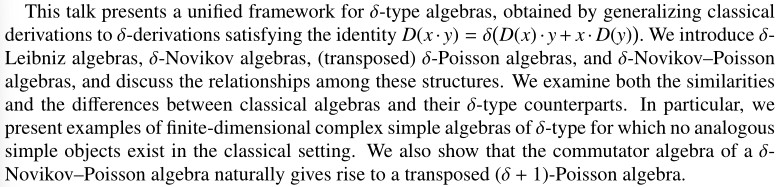
\delta-type algebras
Speaker: Ivan Kaygorodov (University of Beira Interior)
Time: 16:00-18:00, July 2, 2026
Venue: 吉林大学数学楼研讨室5
Abstract:
Bio: Ivan Kaygorodov is a mathematician specializing in nonassociative algebras and superalgebras, as well as various generalizations of Poisson algebras. His work focuses on generalized derivations and the classification of finite-dimensional algebras from different varieties of nonassociative algebras. He obtained his Ph.D. in Mathematics from the Sobolev Institute of Mathematics in 2010. He worked in Brazil for many years and is currently affiliated with the University of Beira Interior (Portugal). Ivan Kaygorodov has authored more than 140 research articles published in international peer-reviewed journals. In recent years, he has served as the coordinator of the European Non-Associative Algebra Network and as the organizer of the European Non-Associative Algebra Weekly Seminar, an international online seminar dedicated to recent advances in nonassociative algebras [https://sites.google.com/view/enaaw/]. He is the Editor-in-Chief of Communications in Mathematics (Scopus Q1, SJR Q1) and the Founding Editor-in-Chief of the Journal of Non-Associative Structures.
Shuffle Algebras and Lie-Theoretic Structures in Free Probability
Speaker: Kurusch Ebrahimi-Fard (Norwegian University of Science and Technology)
Time: 9:00-10:00, 14:00-15:00 June 29, June 30, 2026
Venue: 吉林大学正新楼106
Abstract: This series of introductory lectures presents algebraic and combinatorial structures underlying free probability theory, with particular emphasis on shuffle algebras, pre- and post-Lie structures, and their role in moment-cumulant as well as cumulant-cumulant relations, Wick polynomials, and operator-valued free probability.
Free Probability: The first lecture introduces the basic framework of noncommutative probability, focusing on free, Boolean, and monotone independence. We discuss the notion of cumulants and the corresponding moment-cumulant and cumulant-cumulant relations through the lens of noncrossing partitions and related combinatorial structures. Particular attention is paid to Wick polynomials and their role in organising moment-cumulant relations.
Shuffle Algebra: The second lecture develops the algebraic background of shuffle and unshuffle bialgebras together with associated pre-Lie and post-Lie structures. We explain how these structures naturally arise from combinatorial Hopf algebras and from algebraic approaches to differential equations and Magnus-type expansions.
Shuffle Algebras in Free Probability: In the third lecture, we explain how shuffle algebra methods provide a unified framework for cumulants and Wick calculus in free probability. Half-shuffle exponentials and logarithms lead naturally to (Lie-)algebraic descriptions of free, Boolean, and monotone cumulants as well as recursive constructions of Wick products.
Operator-Valued Free Probability: The final lecture turns to operator-valued free probability and recent developments involving post-Lie algebras. We explain how post-Lie structures naturally encode noncommutative and operator-valued aspects of cumulant theory and discuss connections with Magnus expansions, noncommutative stochastic analysis, and applications to quantum probability.
The lectures aim to highlight the interplay between combinatorics, Hopf algebras, and Lie theory in modern free probability.
Bio: Kurusch Ebrahimi-Fard was born in Cologne, Germany, and received his Ph.D. in Theoretical Physics from the University of Bonn under the supervision of D. Kreimer and R. Flume. He has held postdoctoral positions at several institutions, including the IHES (Bures-sur-Yvette), the Max Planck Institute for Mathematics in Bonn, the Universidad de Zaragoza, and the ICMAT in Madrid. During his time in Spain, he was awarded both the Juan de la Cierva and Ramón y Cajal fellowships. He has also been a fellow of the Studienstiftung des Deutschen Volkes, the Evangelisches Studienwerk, the German Academic Exchange Service (DAAD), and the European Post-Doctoral Institute. He is currently Professor of Mathematics at the Department of Mathematical Sciences, NTNU, Trondheim, Norway, and an elected member of the Royal Norwegian Society of Sciences and Letters (DKNVS).
His research lies at the interface of algebra and combinatorics, with a dual emphasis on theory and applications. Central topics include Magnus-type expansions, combinatorial Hopf algebras, shuffle-type bialgebras, Rota–Baxter algebras, pre- and post-Lie algebras and groups, (Lie–)Butcher series, signature methods, Chen–Fliess series, combinatorial Dyson–Schwinger equations, non-crossing partitions, and operads. A unifying theme of his work is the development of algebraic and combinatorial structures as tools for modeling and analyzing phenomena across a range of areas, including Lie group methods for differential equations, stochastic calculus, free probability theory, control theory, rough paths, quantum machine learning, Hairer's regularity structures, renormalization in perturbative quantum field theory, and multiple zeta values.
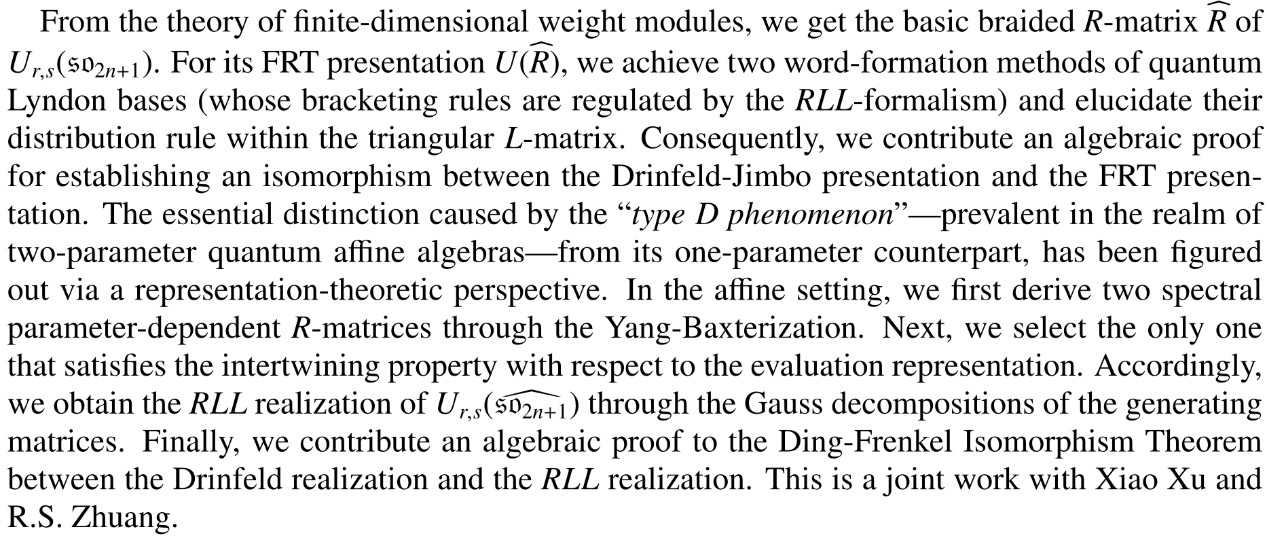
The Ding-Frenkel Isomorphism Theorem for two-parameter quantum affine algebra 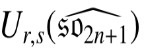 and beyond
Speaker: Naihong Hu (East China Normal University)
Time: 8:30-9:30, May 30, 2026
Venue: 吉林大学正新楼209
Abstract:
Bio: 胡乃红,华东师范大学数学学院教授、博导,华东师大中法基础数学联合实验室LIA执行主任,德国洪堡学者,从事李理论、量子群及Hopf代数结构与表示论研究,近年来对量子群表示论、有限张量范畴理论、量子拓扑和拓扑量子计算前沿研究热点感兴趣。现任SCI杂志Frontiers Math.编委。曾获得教育部霍英东奖(研究类)二等奖,第三届教育部优秀教师教学科研奖励计划暨教育部青年教师奖(部优青),上海市启明星计划和追踪计划。多次主持国家自然科学基金面上项目,两次参与国家自然科学基金重点项目,并与美国北卡州立大学景乃桓教授合作,获得基金委海外青年合作研究基金。在Crelle J.、Comm. Math. Phys.、Israel J. Math.、J. Algebra等国际学术刊物发表高水平学术论文80余篇。
The Permutation Automorphism Groups of Irreducible Cyclic Codes
Speaker: Qing Xiang (Southern University of Science and Technology)
Time: 10:00-12:00,May 18, 2026
Venue: 吉林大学数学楼第五研讨室
Abstract: The study of permutation automorphism groups of cyclic codes is a central topic in algebraic coding theory. A cyclic code over Fq is called irreducible if its check polynomial is irreducible over Fq. Such a code is standard if its permutation automorphism group is equal to the group generated by the cyclic shift and the Frobenius automorphism, and non-standard otherwise. In this talk, we give a complete classification of all non-standard non-degenerate irreducible cyclic codes, using the classification of finite simple groups. Our result shows that, apart from a small number of explicit exceptional families and their descendants under certain secondary constructions, every non-degenerate irreducible cyclic code is standard, and up to four explicit exceptions, every degenerate cyclic code is non-standard.
Bio: 向青为南方科技大学数学系讲席教授, 现任数学系系主任。向青教授的主要研究方向为组合设计、有限几何、编码理论,极值组合和加法组合。在顶尖数学综合期刊《Advances in Math.》,《Trans. AMS》和国际组合数学界最高级别杂志《J. Combin. Theory Ser. A》,《J. Combin. Theory Ser. B》, 《Combinatorica》等重要国际期刊上发表学术论文100余篇。于1999年荣获了国际组合数学及其应用协会颁发的Kirkman奖章。主持完成美国国家自然科学基金、中国自然科学基金海外和港澳合作、中国自然科学基金重点项目等科研项目10余项。曾在国际学术会议上作大会报告或特邀报告60余次。
Deformations of log-canonical Poisson brackets
Speaker: Mykola Matviichuk (The Chinese University of Hong Kong)
Time: 9:00-11:00, May 18, May 20, May 22, May 26, May 27, May 29, 2026
Venue: 吉林大学伍卓群楼3楼多功能厅2
Abstract: A Poisson bracket on a space X is a Lie algebra structure on the space of functions on X that behaves like a derivative in both its arguments. I will discuss the deformation theory of Poisson brackets, which is controlled by the so-called Poisson cohomology. The deformations log-canonical Poisson brackets will be discussed in a great detail. Applications to Lie theory will be presented. The mini-course is based on joint works with Brent Pym, Travis Schedler and Jiang-Hua Lu.
Bio: Mykola Matviichuk is an assistant professor at the Department of Mathematics in the Chinese University of Hong Kong. He is interested in the study of symplectic geometry, algebraic geometry, deformation theory and Poisson geometry. He has published papers in Geom. Topol., Selecta Math., J. Algebraic Geom., Int. Math. Res. Not. IMRN and other journals.
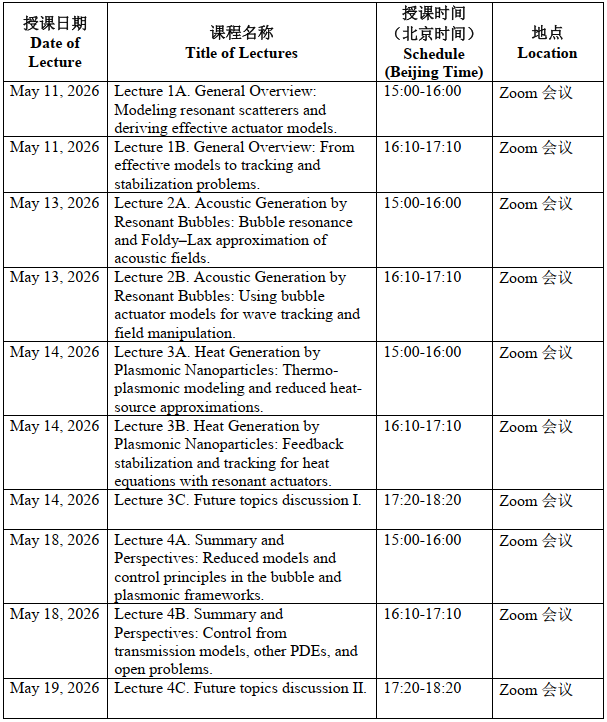
From Resonant Scatterers to PDE Control
Speaker: Mourad Sini (Austrian Academy of Sciences)
Time: 2026年05月11日-18日
Venue: Zoom 会议(会议链接请联系 tangrx23@mails.jlu.edu.cn 获取)
Abstract: This lecture series explores a control-theoretic use of small resonant scatterers in partial differential equations. The main idea is that suitably chosen micro-resonant inhomogeneities, such as bubbles or plasmonic nanoparticles, can be interpreted and designed as effective actuators for wave and heat equations. The first lecture introduces the general philosophy of the series: starting from physical resonance mechanisms, one derives effective point-actuator models of Foldy–Lax type and uses them to orient the analysis toward tracking and stabilization problems in control theory. The next two lectures develop this program in two representative settings, namely acoustic field generation by clusters of bubbles and heat generation by plasmonic nanoparticles. The final lecture synthesizes these case studies and discusses broader perspectives, including the use of reduced models for control design, direct control questions at the level of the original transmission problems, and possible extensions to other systems such as elasticity and other hybrid models. In this way, the series of lectures emphasizes that asymptotic reduction is the key step that connects resonance theory with PDE control.
Bio: M. Sini got his PhD degree from University of Provence, France, in October 2002. From September 2006, he joined the Radon Institute, of the Austrian Academy of Sciences, where he was tenured since 2011 as a senior fellow (equivalent to university professor) after securing the Habilitation degree from J. Kepler University in 2009. M. Sini was invited to deliver the IAAM Award Lecture (Sweden, August 2019) and an invited plenary speaker in the Applied Inverse Problems (AIP) conference (Grenoble, France, July 2019). He attracted around 2 Mi euro as third-party funding. M. Sini is interested in the analysis of partial differential equations applied to inverse problems, mathematical imaging, mathematical therapy and material theory. By now, he published nearly 100 papers, most of them in top journals, several book chapters and co-edited a book. He is member of the editorial board of several journals including Mathematical Methods in Applied Sciences (Wiley) and Communication on Analysis and Computation (AIMS).
Schedule:
Poisson cohomology and linearization
Speaker: Florian Michael Zeiser (Institute for Basic Science)
Time: 9:00-11:00, May 12, 2026, May 13, 2026, May 14, 2026
Venue: 吉林大学伍卓群楼3楼多功能厅2
Abstract: The (non-)existence of a local form is an important question for any geometric structure. The non existence of a local normal form in Riemannian geometry implies the existence of local invariants, e.g. curvature, while the existence of a local normal form for a symplectic structure implies that we can not distinguish such manifolds locally. In this minicourse we investigate this question for Poisson structures.
In the first lecture we introduce the basics of Poisson geometry. Starting from a Poisson bracket, we give a reinterpretation in terms of bivector fields and take a first step towards a local normal form theorem with Weinstein's splitting theorem. Moreover, we will see that any Poisson structure induces a symplectic foliation and provide various examples.
Any Poisson structure induce a cohomology, Poisson cohomology. In the second part, we discuss its importance in Poisson geometry and different methods which allow us to compute Poisson cohomology in some cases. Finally, in the third part of this minicourse we discuss the (non)existence of normal forms, i.e. the question of linearization in Poisson geometry, and the role of Poisson cohomology to answer it.
Bio: Florian Michael Zeiser is a Research Fellow at the Institute for Basic Science in the Center for Geometry and Physics in Pohang. He is interested in the study of geometric structures such as folitations, symplectic geometry and Poisson geometry. He has published papers in Memoirs of the AMS, Journal of Symplectic Geometry, Journal of Algebra and other journals.
Skew Braces: Structure and Connections
Speaker: Lorenzo Stefanello (University of Pisa)
Time: May 07, 2026, 13:00-15:00
Venue: Zoom ID:904 645 6677, Password:2026
Link: https://us06web.zoom.us/j/9046456677?pwd=CWu8WvANi9ohJh4OW91sTVqBM9zsOT.1&omn=86972689584
Abstract: Skew braces are algebraic structures equipped with two group operations interacting in a compatible way, and have attracted increasing attention due to their rich structure and connections with various areas of algebra. In this talk, we introduce skew braces through basic examples and discuss some of the motivations behind their study. We then focus on three main problems arising in this context. First, we investigate the relationship between the two group operations, including results related to a conjecture of Byott, classification results in specific cases, and connections with radical rings and problems concerning unit groups of rings. Second, we present results related to Hopf–Galois structures, illustrating how skew braces provide a natural framework for studying these objects and describing some recent developments. Finally, we introduce Rota–Baxter operators in this context, showing how they arise naturally from the problem of constructing skew braces, and examining the question of whether all skew braces can be obtained in this way.
Bio: Lorenzo Stefanello is a mathematician whose research focuses on skew braces and their connections with Hopf–Galois theory. He earned a PhD in Mathematics from the University of Pisa, working at the intersection of abstract algebra and algebraic number theory.
The Universal Post-Lie-Rinehart Algebra of Planar Aromatic Trees
Speaker: Ludwig Rahm (University of Geneva)
Time: April 23, 2026, 21:00-23:00
Venue: Zoom ID:904 645 6677, Password:2026
Link: https://us06web.zoom.us/j/9046456677?pwd=CWu8WvANi9ohJh4OW91sTVqBM9zsOT.1&omn=86972689584
Abstract: Aromatic B-series have been used to study volume-preserving numerical integrators on Euclidean spaces. One important result in the success of aromatic B-series is that each aromatic B-series method can be represented by an element in the free tracial pre-Lie-Rinehart algebra. This talk will extend this result to homogeneous spaces. We will first discuss the underlying structures of Lie algebroids, Lie-Rinehart algebras and post-Lie algebras. We will then arrive at a natural definition for tracial post-Lie-Rinehart algebras, and will describe the free object in this category.
Bio: Ludwig Rahm defended his PhD at Norwegian University of Science and Technology in December 2024 under the supervision of Kurusch Ebrahimi-Fard and Hans Zanna Munthe-Kaas. He is currently a Post-doc at University of Geneva under the supervision of Gilles Vilmart.
Pre-Lie and Post-Lie algebras in combinatorics and geometry
Speaker: Paul Laubie (Université de Lorraine)
Time: April 16, 2026, 21:00-23:00
Venue: Zoom ID:904 645 6677, Password:2026
Link: https://us06web.zoom.us/j/9046456677?pwd=CWu8WvANi9ohJh4OW91sTVqBM9zsOT.1&omn=86972689584
Abstract: After a brief recollection on the algebraic structure on vector field of manifold, we will state the theorem of Joyal linking Lie algebras and partitions of finite sets. We will show how operads allow us to strengthen this link between combinatorics of posets and algebraic structures via Koszul duality. Finally, we will discuss applications of the combinatorial description of those algebraic structures.
Bio: Paul Laubie defended his PhD at the university of Strasbourg in May 2024 under the supervision of Vladimir Dotsenko, and he is currently a Post-doc at Université de Lorraine under the supervision of Yvain Bruned. His mathematical interest is at the intersection between homological (or homotopical) algebra and combinatorics with an emphasis on applications to other mathematical domains such as numerical analysis or stochastic differential equations.
Reflection theory for (quasi-)Hopf algebras
Speaker: Gongxiang Liu (Nanjing University)
Time: April 09, 2026, 10:00-11:00
Venue: Zoom ID:904 645 6677, Password:2026
Link: https://us06web.zoom.us/j/9046456677?pwd=CWu8WvANi9ohJh4OW91sTVqBM9zsOT.1&omn=86972689584
Abstract: Reflection theory for Hopf algebras is a fundamental tool for classification of pointed Hopf algebras. Through reflection theory, one can define the corresponding Weyl groupoid and root system theory for Nichols algebras. We will explain this theory in this talk at first. For a long time, we don’t know how to generalize such tool to (co)quasi-Hopf algebras. Secondly, we show that we have such a theory for (co)quasi-Hopf algebras with bijective antipode briefly. This is a joint work with Dr. Bowen Li.
Bio: 刘公祥,南京大学数学学院教授、博士生导师,南京大学数学学院党委书记。长期从事代数学方面的研究工作,在J. Reine Angew Math.、Trans. Amer. Math. Soc.、Adv. Math.、Comm. Math. Phys., Israel J. Math.等国际重要SCI期刊上发表多篇学术论文。多次受邀在国内外学术会议上作大会报告,曾获霍英东教育基金会中国高校青年教师奖、江苏省数学杰出成就奖等,2017年获国家自然科学基金优秀青年基金支持。
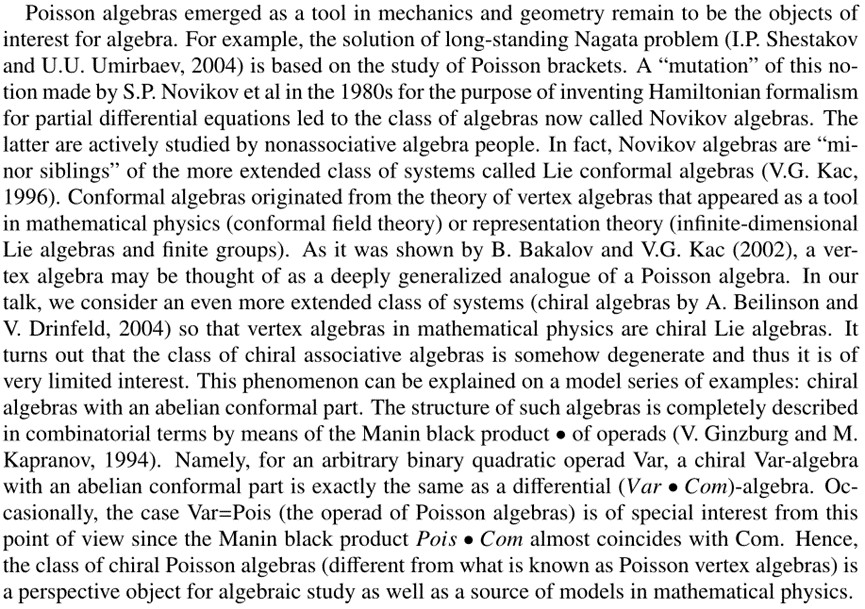
Chiral algebras and the Manin product of operads
Speaker: Pavel Kolesnikov (Sobolev Institute of Mathematics)
Time: March 30, 2026, 16:00-18:00
Venue: 吉林大学数学楼第五研讨室
Abstract:
Bio: Pavel Kolesnikov is a research member of the Sobolev Institute of Mathematics and a professor of Novosibirsk State University. He specializes in the study of non-associative structures emerging in contemporary mathematics, like Rota-Baxter algebras, dendriform algebras, conformal and vertex algebras, etc.
Symmetric Poisson geometry, totally geodesic foliations and Jacobi-Jordan algebras
Speaker: Roberto Rubio (Autonomous University of Barcelona)
Time: March 12, 2026, 15:00-16:00
Venue: Zoom ID:904 645 6677, Password:2026
Link: https://us06web.zoom.us/j/9046456677?pwd=CWu8WvANi9ohJh4OW91sTVqBM9zsOT.1&omn=86972689584
Abstract: I will introduce symmetric Poisson geometry, the study of symmetric bivector fields on a manifold. I will first discuss their integrability condition, then move to their geometric interpretation, which features totally geodesic foliations, and finally discuss some interesting examples, including their connection to Jacobi-Jordan algebras. This is joint work with Filip Moucka, available on arXiv2508.15890.
Bio: Roberto Rubio is a Ramón y Cajal researcher at the Autonomous University of Barcelona and the PI of the research grants GENTLE and DÉCOLLAGE. He first worked on Higgs bundles (PhD, ICMAT 2012) and then developed generalized geometry of type Bn (PhD, Oxford 2015). He has been a postdoctoral fellow at IMPA, where he worked on Dirac structures, and the Weizmann Institute of Science, where he worked on Gelfand pairs, as well as a Marie Skłodowska-Curie Individual Fellow. He is an expert on generalized geometry and Courant algebroids, with a special focus on the development and study of new geometrical frameworks.
关于某些拟线性椭圆方程解的分类与刘维尔性质的新进展
Speaker: 王友德 (广州大学)
Time: 2026年1月8日, 10:00-11:00
Venue: 腾讯会议:290-429-573
Abstract:
我们将介绍定义在具非负里奇曲率的非紧完备流形上的拟线性退化Lane-Emden方程

的最佳Liouville定理及如何使用Nash-Moser迭代获得一类拟线性退化椭圆方程正解的最佳形式的统一的郑-丘(Cheng-Yau)型梯度估计。我们也将介绍定义在里奇曲率非负的非紧黎曼流形上的临界p-Laplace方程正解的分类及刚性等。
Bio: 王友德,教授,博士生导师,国家杰出青年基金获得者,“百千万人才工程”国家级人选。在调和映射、几何流及其相关问题上进行了长期的研究,取得了一系列具有学术价值的成果。曾提出在国际上引发一系列后续研究的薛定谔几何流的概念及率先获得其局部适定性;解决了阿尔法调和映射序列收敛产生泡泡时能量恒等式是否成立等公开问题。
Previous lectures and talks:
Previous lectures and talks: